Type C Multi-Cell Lithium Battery Charger Board
Official Store Deal
Expert Analysis Overview
The DDTTCCRUB Type-C Lithium Battery Charger is a highly adaptable power management module engineered for hobbyists and professionals building custom multi-cell lithium battery packs. This compact board addresses the critical need for flexible, efficient charging solutions in diverse portable electronics and DIY projects. Its design prioritizes integration and configurable performance over a one-size-fits-all approach.
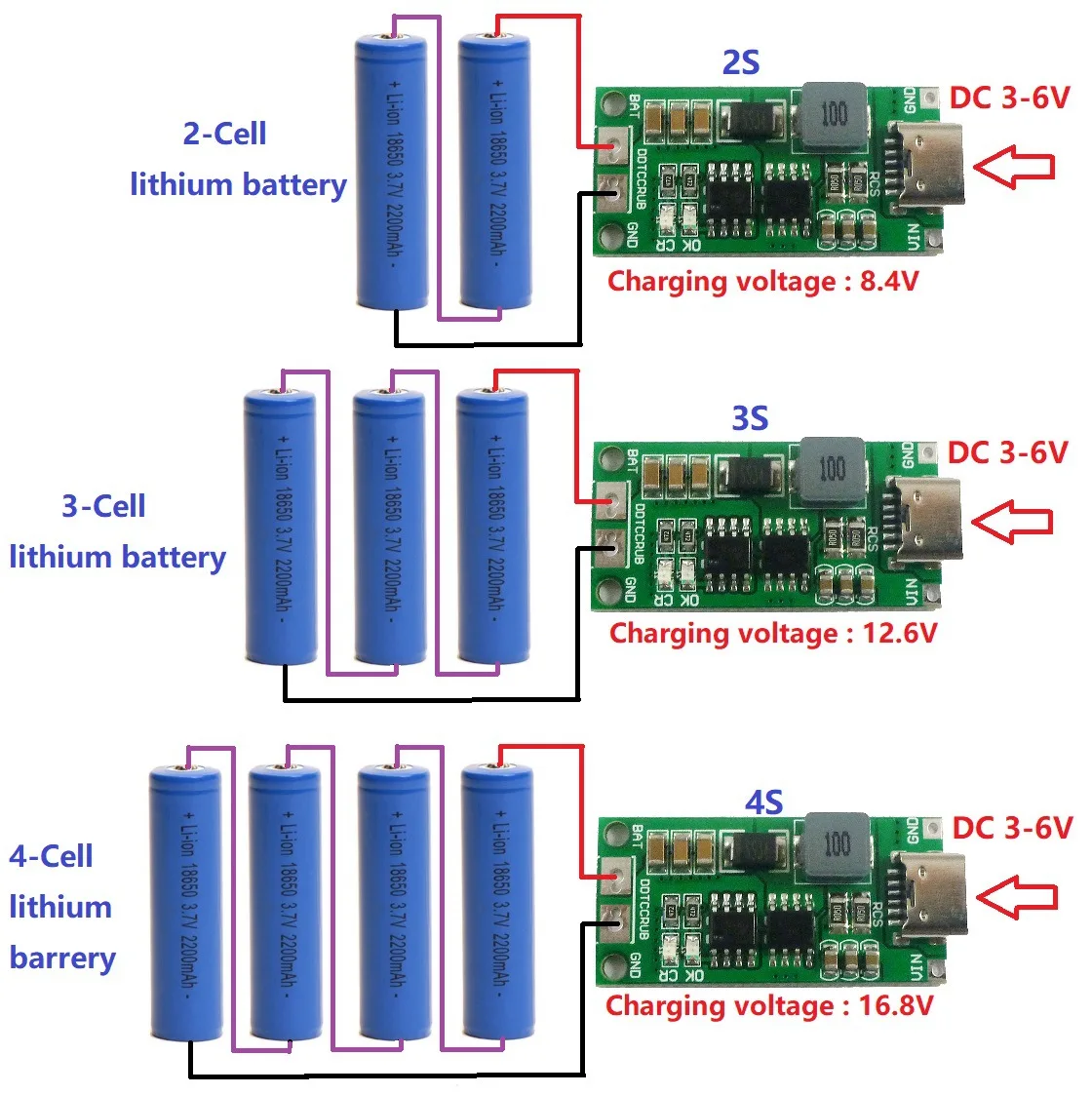
The core utility of this charging module lies in its ability to support multiple lithium battery pack configurations. Visual evidence from the product diagrams clearly illustrates compatibility with 2-cell (2S), 3-cell (3S), and 4-cell (4S) lithium battery arrays. This means the board can deliver charging voltages of 8.4V, 12.6V, and 16.8V respectively, covering a wide spectrum of common power requirements. Such adaptability is crucial for projects ranging from custom drone batteries to portable audio systems.
Unlike generic single-cell chargers, which limit design possibilities, this module provides the necessary voltage regulation for series-connected cells. A user building a 12V power tool battery pack, for instance, can configure this board for 3S operation. This flexibility significantly reduces the need for multiple specialized chargers. It's a single solution for varied voltage needs.
Standard charging solutions often force users into a fixed cell count. This module, however, allows for dynamic adjustment. The ability to select the cell count via solder pads on the PCB's underside, as depicted in the second and sixth images, presents a tangible advantage. This configuration method, while requiring soldering, ensures a robust and permanent setting once applied.
Power input options further enhance the module's versatility. The board accepts power through a modern Type-C USB port or via traditional DC 3-6V solder pads. This dual input capability ensures compatibility with ubiquitous 5V USB power sources, like wall adapters or power banks, as well as lower voltage DC supplies. The Type-C input is a significant upgrade.
For users accustomed to micro-USB or barrel jack inputs on similar modules, the Type-C port simplifies cable management. It also aligns with contemporary power delivery standards. The module supports selectable charging currents of 1A, 2A, and 4A. This allows for optimization based on battery capacity and desired charging speed. A larger battery pack benefits from a higher current.
Many basic charger boards offer only a fixed charging current. This module's selectable current feature provides a critical level of control. For smaller battery packs, 1A charging prevents undue stress, extending battery lifespan. Conversely, a 4A setting can significantly reduce charge times for larger capacity packs, provided the input power source can deliver the required current. The third image explicitly warns that the 4A version necessitates a Type-C power supply capable of outputting 4A, highlighting the importance of matching the power source to the chosen charging profile.
At its core, this module functions as a step-up boost charger. This means it can take a lower input voltage, such as 5V from a standard USB-C adapter, and convert it to the higher voltages required for 2S (8.4V), 3S (12.6V), or 4S (16.8V) lithium battery packs. This boost capability is fundamental for charging multi-cell packs from common 5V sources. Without it, a dedicated higher voltage power supply would be mandatory.
The integrated inductor, prominently visible in the fourth image, is a key component in this boost conversion process. It stores and releases energy to step up the voltage efficiently. This precise voltage regulation is paramount for lithium battery health. Overcharging or undercharging can severely degrade battery performance and safety. The board's design aims to deliver the exact voltage required for each cell configuration.
Compared to simpler linear chargers, a boost converter offers superior efficiency, especially when the input voltage is significantly lower than the output. This efficiency translates to less heat generation and more power delivered to the battery. It's a smarter way to charge. The charging voltage specifications (8.4V, 12.6V, 16.8V) are precisely matched to the full charge voltage of standard lithium cells (4.2V per cell).
The physical layout of the PCB, as observed in the detailed images, suggests a design focused on functional integration within a small footprint. The surface-mount components are tightly packed, yet the inductor, often a source of heat, appears adequately sized for its current ratings. Effective heat dissipation is crucial for the longevity and reliability of any power electronics. While a heatsink is not present, the board's intended current levels for its size imply careful component selection.
Operating at higher currents, particularly the 4A setting, will naturally generate more heat. The explicit warning in the third image about providing a robust power supply and "good soldering" for 2A/4A versions indirectly points to thermal management. Proper soldering ensures low resistance connections, minimizing localized heat generation at contact points. This is a critical detail for sustained performance.
Unlike modules that cut corners on component quality, the visible inductor and ICs appear standard for their class. The green PCB material is a common FR-4 substrate, offering adequate thermal conductivity for the board's power density. Users integrating this module into enclosed spaces must consider airflow. Adequate ventilation prevents thermal throttling.
This charger board is an ideal candidate for a multitude of DIY power solutions. Its compact size, approximately 25mm x 17mm (estimated from images), allows for integration into small enclosures. Imagine building a custom portable speaker with a 3S lithium battery pack. This module provides the charging capability without adding significant bulk. It's a core component for custom electronics.
The ability to power the board via Type-C USB makes it particularly attractive for modern projects. Many single-board computers and microcontrollers now use Type-C for power. This allows for a unified power input strategy. For example, a custom IoT device powered by a 2S battery pack could use the same Type-C cable for both charging and data transfer (if the main device supports it). This streamlines the user experience.
Traditional DIY battery chargers often rely on older barrel jack connectors or require custom wiring for power input. The Type-C integration simplifies the external interface. This reduces the number of unique components required for a project. It also enhances user convenience.
The module's suitability for "Li-Po Polymer Power Bank" applications, as mentioned in the product title, underscores its role in portable energy storage. Building a custom power bank with specific voltage requirements, perhaps for a specialized camera or field equipment, becomes feasible. The selectable current allows for faster charging of the power bank itself. This is a significant advantage.
Consider a scenario where a user needs to power a 12V device in the field. A standard 5V USB power bank won't suffice. By integrating this 3S capable charger board with a 3S battery pack, a custom 12V power bank can be created. This provides a tailored power solution. The module essentially bridges the gap between common 5V USB infrastructure and higher voltage battery requirements.
Compared to commercially available power banks, which often have fixed output voltages, this module enables the creation of highly customized solutions. It offers the power user the freedom to design a power source precisely matched to their specific application. This capability is invaluable for niche projects. The robust solder pads for battery connections ensure reliable power transfer, critical for high-current applications.
The selectable current options (1A, 2A, 4A) are not merely arbitrary numbers; they represent distinct performance tiers. A 1A charge is suitable for smaller packs or trickle charging, minimizing heat and maximizing battery lifespan. The 2A option provides a balanced approach for medium-sized packs. For rapid replenishment of larger capacity 2S, 3S, or 4S packs, the 4A setting becomes essential. This flexibility directly impacts project timelines.
The efficiency of the boost converter circuit is critical for minimizing energy loss during charging. While specific efficiency figures are not provided, the presence of a substantial inductor and multiple ICs suggests a well-engineered switching regulator. Inefficient designs lead to wasted power as heat. This impacts both charging speed and the overall thermal management of the system.
Users should be aware that achieving the full 4A charging current requires a robust power source. A standard 5V/2A USB charger will not be sufficient for the 4A setting. This is a practical limitation, not a flaw of the board itself. It simply means the user must match their input supply to their desired output performance.
The visible components and PCB construction indicate a standard level of durability for hobbyist electronics. The solder pads are clearly labeled and appear to offer sufficient surface area for reliable connections. Good soldering technique is paramount for the long-term reliability of any DIY electronic project. Cold solder joints or inadequate wire gauge can lead to intermittent operation or even failure.
The compact nature of the board means it is susceptible to physical damage if not properly housed. Integrating it into an enclosure is highly recommended. This protects the delicate surface-mount components from environmental factors and accidental impact. A well-protected module ensures sustained performance.
Unlike consumer-grade products with molded cases, this bare PCB requires user intervention for protection. This is a trade-off for its low cost and high configurability. The "DDTTCCRUB" branding on the bottom of the board indicates a specific manufacturer, suggesting a consistent production process. This consistency is important for repeatable project builds.
This module empowers the power user to move beyond off-the-shelf solutions. It provides the granular control necessary for optimizing custom battery systems. The combination of multi-cell support, flexible input, and selectable charging currents makes it a versatile tool in any electronics enthusiast's arsenal. It's not just a charger; it's a building block for advanced power management.
Imagine completing a custom portable workstation, knowing its power source is precisely tuned for optimal performance and longevity. This board provides that assurance. The ability to quickly charge a high-voltage battery pack from a common Type-C adapter simplifies field operations. This module delivers the capability to design, build, and maintain sophisticated portable power systems with confidence and efficiency.
Adaptive Power Delivery Architecture
Multi-Cell Configuration Versatility
The core utility of this charging module lies in its ability to support multiple lithium battery pack configurations. Visual evidence from the product diagrams clearly illustrates compatibility with 2-cell (2S), 3-cell (3S), and 4-cell (4S) lithium battery arrays. This means the board can deliver charging voltages of 8.4V, 12.6V, and 16.8V respectively, covering a wide spectrum of common power requirements. Such adaptability is crucial for projects ranging from custom drone batteries to portable audio systems.
Unlike generic single-cell chargers, which limit design possibilities, this module provides the necessary voltage regulation for series-connected cells. A user building a 12V power tool battery pack, for instance, can configure this board for 3S operation. This flexibility significantly reduces the need for multiple specialized chargers. It's a single solution for varied voltage needs.
Standard charging solutions often force users into a fixed cell count. This module, however, allows for dynamic adjustment. The ability to select the cell count via solder pads on the PCB's underside, as depicted in the second and sixth images, presents a tangible advantage. This configuration method, while requiring soldering, ensures a robust and permanent setting once applied.
Input Flexibility and Current Management
Power input options further enhance the module's versatility. The board accepts power through a modern Type-C USB port or via traditional DC 3-6V solder pads. This dual input capability ensures compatibility with ubiquitous 5V USB power sources, like wall adapters or power banks, as well as lower voltage DC supplies. The Type-C input is a significant upgrade.
For users accustomed to micro-USB or barrel jack inputs on similar modules, the Type-C port simplifies cable management. It also aligns with contemporary power delivery standards. The module supports selectable charging currents of 1A, 2A, and 4A. This allows for optimization based on battery capacity and desired charging speed. A larger battery pack benefits from a higher current.
Many basic charger boards offer only a fixed charging current. This module's selectable current feature provides a critical level of control. For smaller battery packs, 1A charging prevents undue stress, extending battery lifespan. Conversely, a 4A setting can significantly reduce charge times for larger capacity packs, provided the input power source can deliver the required current. The third image explicitly warns that the 4A version necessitates a Type-C power supply capable of outputting 4A, highlighting the importance of matching the power source to the chosen charging profile.
Precision Charging Dynamics
Voltage Regulation and Boost Functionality
At its core, this module functions as a step-up boost charger. This means it can take a lower input voltage, such as 5V from a standard USB-C adapter, and convert it to the higher voltages required for 2S (8.4V), 3S (12.6V), or 4S (16.8V) lithium battery packs. This boost capability is fundamental for charging multi-cell packs from common 5V sources. Without it, a dedicated higher voltage power supply would be mandatory.
The integrated inductor, prominently visible in the fourth image, is a key component in this boost conversion process. It stores and releases energy to step up the voltage efficiently. This precise voltage regulation is paramount for lithium battery health. Overcharging or undercharging can severely degrade battery performance and safety. The board's design aims to deliver the exact voltage required for each cell configuration.
Compared to simpler linear chargers, a boost converter offers superior efficiency, especially when the input voltage is significantly lower than the output. This efficiency translates to less heat generation and more power delivered to the battery. It's a smarter way to charge. The charging voltage specifications (8.4V, 12.6V, 16.8V) are precisely matched to the full charge voltage of standard lithium cells (4.2V per cell).
Thermal Considerations and Component Integrity
The physical layout of the PCB, as observed in the detailed images, suggests a design focused on functional integration within a small footprint. The surface-mount components are tightly packed, yet the inductor, often a source of heat, appears adequately sized for its current ratings. Effective heat dissipation is crucial for the longevity and reliability of any power electronics. While a heatsink is not present, the board's intended current levels for its size imply careful component selection.
Operating at higher currents, particularly the 4A setting, will naturally generate more heat. The explicit warning in the third image about providing a robust power supply and "good soldering" for 2A/4A versions indirectly points to thermal management. Proper soldering ensures low resistance connections, minimizing localized heat generation at contact points. This is a critical detail for sustained performance.
Unlike modules that cut corners on component quality, the visible inductor and ICs appear standard for their class. The green PCB material is a common FR-4 substrate, offering adequate thermal conductivity for the board's power density. Users integrating this module into enclosed spaces must consider airflow. Adequate ventilation prevents thermal throttling.
Integration and Application Horizons
DIY Power Solutions
This charger board is an ideal candidate for a multitude of DIY power solutions. Its compact size, approximately 25mm x 17mm (estimated from images), allows for integration into small enclosures. Imagine building a custom portable speaker with a 3S lithium battery pack. This module provides the charging capability without adding significant bulk. It's a core component for custom electronics.
The ability to power the board via Type-C USB makes it particularly attractive for modern projects. Many single-board computers and microcontrollers now use Type-C for power. This allows for a unified power input strategy. For example, a custom IoT device powered by a 2S battery pack could use the same Type-C cable for both charging and data transfer (if the main device supports it). This streamlines the user experience.
Traditional DIY battery chargers often rely on older barrel jack connectors or require custom wiring for power input. The Type-C integration simplifies the external interface. This reduces the number of unique components required for a project. It also enhances user convenience.
Optimizing Portable Energy Storage
The module's suitability for "Li-Po Polymer Power Bank" applications, as mentioned in the product title, underscores its role in portable energy storage. Building a custom power bank with specific voltage requirements, perhaps for a specialized camera or field equipment, becomes feasible. The selectable current allows for faster charging of the power bank itself. This is a significant advantage.
Consider a scenario where a user needs to power a 12V device in the field. A standard 5V USB power bank won't suffice. By integrating this 3S capable charger board with a 3S battery pack, a custom 12V power bank can be created. This provides a tailored power solution. The module essentially bridges the gap between common 5V USB infrastructure and higher voltage battery requirements.
Compared to commercially available power banks, which often have fixed output voltages, this module enables the creation of highly customized solutions. It offers the power user the freedom to design a power source precisely matched to their specific application. This capability is invaluable for niche projects. The robust solder pads for battery connections ensure reliable power transfer, critical for high-current applications.
Performance and Reliability Considerations
Current Delivery and Efficiency
The selectable current options (1A, 2A, 4A) are not merely arbitrary numbers; they represent distinct performance tiers. A 1A charge is suitable for smaller packs or trickle charging, minimizing heat and maximizing battery lifespan. The 2A option provides a balanced approach for medium-sized packs. For rapid replenishment of larger capacity 2S, 3S, or 4S packs, the 4A setting becomes essential. This flexibility directly impacts project timelines.
The efficiency of the boost converter circuit is critical for minimizing energy loss during charging. While specific efficiency figures are not provided, the presence of a substantial inductor and multiple ICs suggests a well-engineered switching regulator. Inefficient designs lead to wasted power as heat. This impacts both charging speed and the overall thermal management of the system.
Users should be aware that achieving the full 4A charging current requires a robust power source. A standard 5V/2A USB charger will not be sufficient for the 4A setting. This is a practical limitation, not a flaw of the board itself. It simply means the user must match their input supply to their desired output performance.
Long-Term Durability and Assembly
The visible components and PCB construction indicate a standard level of durability for hobbyist electronics. The solder pads are clearly labeled and appear to offer sufficient surface area for reliable connections. Good soldering technique is paramount for the long-term reliability of any DIY electronic project. Cold solder joints or inadequate wire gauge can lead to intermittent operation or even failure.
The compact nature of the board means it is susceptible to physical damage if not properly housed. Integrating it into an enclosure is highly recommended. This protects the delicate surface-mount components from environmental factors and accidental impact. A well-protected module ensures sustained performance.
Unlike consumer-grade products with molded cases, this bare PCB requires user intervention for protection. This is a trade-off for its low cost and high configurability. The "DDTTCCRUB" branding on the bottom of the board indicates a specific manufacturer, suggesting a consistent production process. This consistency is important for repeatable project builds.
The Power User's Advantage
This module empowers the power user to move beyond off-the-shelf solutions. It provides the granular control necessary for optimizing custom battery systems. The combination of multi-cell support, flexible input, and selectable charging currents makes it a versatile tool in any electronics enthusiast's arsenal. It's not just a charger; it's a building block for advanced power management.
Imagine completing a custom portable workstation, knowing its power source is precisely tuned for optimal performance and longevity. This board provides that assurance. The ability to quickly charge a high-voltage battery pack from a common Type-C adapter simplifies field operations. This module delivers the capability to design, build, and maintain sophisticated portable power systems with confidence and efficiency.