Infrared Proximity Obstacle Sensor Module
Official Store Deal
Expert Analysis Overview
The Infrared Proximity Obstacle Sensor Module is a fundamental component for hobbyists and developers building responsive automation systems. This compact unit offers a straightforward method for detecting object presence, making it an indispensable building block for custom smart devices and robotic applications.
This sensor operates on the principle of infrared reflection. An integrated IR emitter sends out a continuous beam of infrared light. When this light encounters an object within its detection range, it reflects back towards the module's IR receiver. This simple mechanism forms the basis for numerous automation possibilities.
The detection process is remarkably swift. It provides a digital output signal, indicating either the presence or absence of an obstacle. Such rapid feedback is critical for applications requiring immediate action.
Unlike more complex, multi-protocol sensors, this module focuses on core functionality. It delivers reliable binary data, which a connected microcontroller can interpret and act upon.
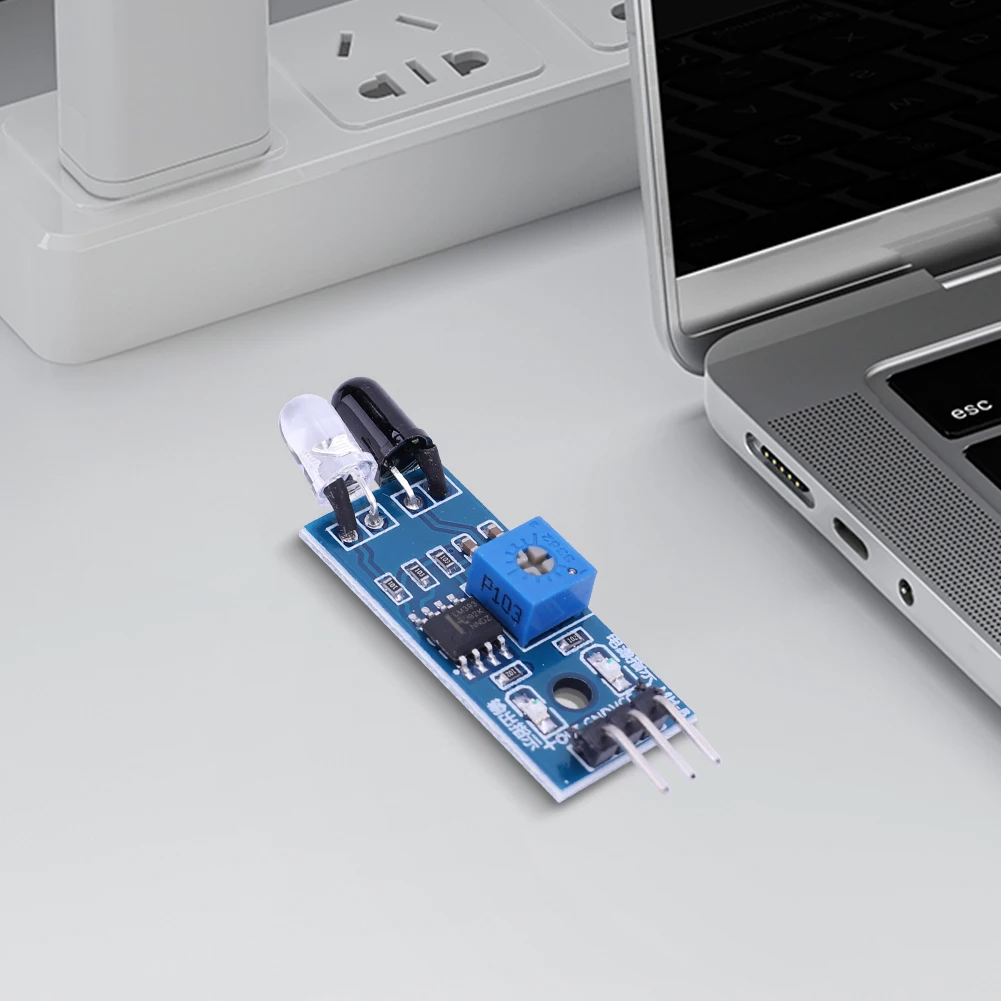
At its heart, the module utilizes an infrared LED as the emitter and a photodiode or phototransistor as the receiver. These two components work in tandem to create a localized detection field. The clear LED visible on the board is the IR emitter, while the black-encapsulated component is the IR receiver. This pairing is standard for reflective obstacle detection.
When infrared light from the emitter strikes an object, a portion of that light bounces back. The receiver then picks up this reflected light. The intensity of the reflected light determines the output.
This simple optical setup ensures a low-cost, effective solution for proximity sensing. It's a foundational element.
A key feature of this module is its adjustable sensitivity, controlled by a small blue potentiometer. This allows the detection range and responsiveness to be finely tuned for specific application requirements. For instance, a robot navigating a cluttered environment might need a shorter, more precise detection range to avoid false positives from distant objects.
Adjusting the potentiometer changes the threshold at which the comparator IC triggers its output. Turning it clockwise or counter-clockwise will increase or decrease the sensor's sensitivity to reflected IR light. This granular control is a significant advantage.
Standard fixed-range sensors often force developers to compromise. This adjustable design provides flexibility, adapting the sensor to diverse environmental conditions and object types.
Connectivity is achieved via a simple three-pin interface: VCC (power), GND (ground), and OUT (digital output). This direct wiring scheme makes it highly compatible with virtually any microcontroller platform, including popular options like Arduino, ESP32, Raspberry Pi, and other single-board computers.
The digital output provides a clear high or low signal. A high signal typically indicates no obstacle, while a low signal signifies an obstacle detected, or vice-versa, depending on the module's specific logic. This binary output simplifies the programming interface considerably.
Compared to analog sensors that require Analog-to-Digital Converter (ADC) readings and threshold setting in software, this module's digital output streamlines code development. It's plug-and-play for digital inputs.
While this sensor does not natively support smart home protocols like Zigbee, Z-Wave, or Matter, its integration into a broader smart home ecosystem is entirely feasible through a microcontroller bridge. An ESP32, for example, can read the sensor's digital output and then communicate that status over Wi-Fi using protocols like MQTT or HTTP.
Imagine a custom automation script: a small robot detects an object, sends a signal to an ESP32, which then publishes an MQTT message. Home Assistant or Node-RED can subscribe to this message and trigger subsequent actions, such as sending a notification or activating a different device. This creates powerful, interconnected routines.
Native smart home sensors typically come with a higher price point and less flexibility for custom applications. This module, when paired with an open-source microcontroller, offers a highly customizable and cost-effective alternative for niche automation tasks.
The low latency of the digital output ensures quick response times, critical for real-time automation. For instance, in a smart pet feeder, the sensor could detect when the food bowl is empty, triggering a refill mechanism or sending an alert. This immediacy prevents delays in critical operations.
Consider a smart trash can: the sensor detects when a hand approaches, automatically opening the lid. Or, in a robotic vacuum cleaner, it provides essential data for navigating around furniture. Such responsiveness enhances user experience and system efficiency.
Many commercial smart devices rely on similar underlying principles but often hide the complexity. With this module, developers gain full control over the detection logic and subsequent automated actions.
The visible components suggest a standard PCB construction, likely FR-4, which offers good electrical insulation and mechanical strength for typical indoor applications. The through-hole components (LEDs, potentiometer, header pins) are generally robust for hobbyist use, allowing for easy replacement if needed.
Operating voltage is typically 3.3V to 5V, making it compatible with most microcontrollers. Power consumption is minimal, suitable for battery-powered projects. This efficiency is crucial for portable or long-duration autonomous systems.
Unlike industrial-grade sensors designed for harsh environments, this module is intended for educational and DIY projects. Its open design allows for easy inspection and modification.
The module is not enclosed or rated for specific environmental protection (e.g., IP rating). It is best suited for indoor applications where it is protected from dust, moisture, and extreme temperatures. For outdoor or industrial use, custom enclosures would be necessary.
Ambient light can affect its performance, especially direct sunlight or strong artificial light sources that emit significant infrared radiation. The potentiometer helps mitigate some of these effects by allowing sensitivity adjustment, but direct interference can still occur. Proper placement is key.
High-end industrial sensors often incorporate advanced filtering and modulated IR signals to overcome ambient light issues. For its price point, this module offers a pragmatic balance, requiring careful environmental consideration during deployment.
This infrared proximity sensor represents exceptional value for anyone looking to add basic object detection to their electronic projects without significant financial outlay. Its low cost makes experimentation accessible, encouraging iterative design and learning.
The simplicity of its interface reduces the barrier to entry for beginners in electronics and programming. New users can quickly grasp its operation and integrate it into their first automated circuits. This fosters rapid prototyping and skill development.
Compared to proprietary, closed-source smart sensors, this module offers unparalleled flexibility. It empowers users to define their own automation rules, integrate with preferred platforms, and truly own their smart home solutions. It is a foundational tool for custom automation, allowing users to build the specific capabilities they need rather than relying on pre-defined functionalities.
Imagine a home where every routine is streamlined, every task anticipated, and every interaction responsive. This module serves as a critical eye in such a system, enabling custom scripts to react to the physical world. Whether automating a pet's feeding schedule, guiding a robotic assistant, or ensuring a smart bin opens precisely when needed, this sensor provides the tangible link between physical presence and digital action. It provides the capability to create truly unique and personalized automated experiences, transforming a static environment into an interconnected, intelligent space that anticipates needs and simplifies daily life. The potential for innovation and practical application remains vast, providing endless opportunities for custom smart home development.
Architecting Automated Responses
This sensor operates on the principle of infrared reflection. An integrated IR emitter sends out a continuous beam of infrared light. When this light encounters an object within its detection range, it reflects back towards the module's IR receiver. This simple mechanism forms the basis for numerous automation possibilities.
The detection process is remarkably swift. It provides a digital output signal, indicating either the presence or absence of an obstacle. Such rapid feedback is critical for applications requiring immediate action.
Unlike more complex, multi-protocol sensors, this module focuses on core functionality. It delivers reliable binary data, which a connected microcontroller can interpret and act upon.
The Core Detection Mechanism
At its heart, the module utilizes an infrared LED as the emitter and a photodiode or phototransistor as the receiver. These two components work in tandem to create a localized detection field. The clear LED visible on the board is the IR emitter, while the black-encapsulated component is the IR receiver. This pairing is standard for reflective obstacle detection.
When infrared light from the emitter strikes an object, a portion of that light bounces back. The receiver then picks up this reflected light. The intensity of the reflected light determines the output.
This simple optical setup ensures a low-cost, effective solution for proximity sensing. It's a foundational element.
Precision in Proximity: Adjustable Sensitivity
A key feature of this module is its adjustable sensitivity, controlled by a small blue potentiometer. This allows the detection range and responsiveness to be finely tuned for specific application requirements. For instance, a robot navigating a cluttered environment might need a shorter, more precise detection range to avoid false positives from distant objects.
Adjusting the potentiometer changes the threshold at which the comparator IC triggers its output. Turning it clockwise or counter-clockwise will increase or decrease the sensor's sensitivity to reflected IR light. This granular control is a significant advantage.
Standard fixed-range sensors often force developers to compromise. This adjustable design provides flexibility, adapting the sensor to diverse environmental conditions and object types.
Bridging Physical to Digital
Connectivity is achieved via a simple three-pin interface: VCC (power), GND (ground), and OUT (digital output). This direct wiring scheme makes it highly compatible with virtually any microcontroller platform, including popular options like Arduino, ESP32, Raspberry Pi, and other single-board computers.
The digital output provides a clear high or low signal. A high signal typically indicates no obstacle, while a low signal signifies an obstacle detected, or vice-versa, depending on the module's specific logic. This binary output simplifies the programming interface considerably.
Compared to analog sensors that require Analog-to-Digital Converter (ADC) readings and threshold setting in software, this module's digital output streamlines code development. It's plug-and-play for digital inputs.
Integrating into Smart Ecosystems
While this sensor does not natively support smart home protocols like Zigbee, Z-Wave, or Matter, its integration into a broader smart home ecosystem is entirely feasible through a microcontroller bridge. An ESP32, for example, can read the sensor's digital output and then communicate that status over Wi-Fi using protocols like MQTT or HTTP.
Imagine a custom automation script: a small robot detects an object, sends a signal to an ESP32, which then publishes an MQTT message. Home Assistant or Node-RED can subscribe to this message and trigger subsequent actions, such as sending a notification or activating a different device. This creates powerful, interconnected routines.
Native smart home sensors typically come with a higher price point and less flexibility for custom applications. This module, when paired with an open-source microcontroller, offers a highly customizable and cost-effective alternative for niche automation tasks.
Architecting Automation Scripts
The low latency of the digital output ensures quick response times, critical for real-time automation. For instance, in a smart pet feeder, the sensor could detect when the food bowl is empty, triggering a refill mechanism or sending an alert. This immediacy prevents delays in critical operations.
Consider a smart trash can: the sensor detects when a hand approaches, automatically opening the lid. Or, in a robotic vacuum cleaner, it provides essential data for navigating around furniture. Such responsiveness enhances user experience and system efficiency.
Many commercial smart devices rely on similar underlying principles but often hide the complexity. With this module, developers gain full control over the detection logic and subsequent automated actions.
Operational Considerations and Durability
The visible components suggest a standard PCB construction, likely FR-4, which offers good electrical insulation and mechanical strength for typical indoor applications. The through-hole components (LEDs, potentiometer, header pins) are generally robust for hobbyist use, allowing for easy replacement if needed.
Operating voltage is typically 3.3V to 5V, making it compatible with most microcontrollers. Power consumption is minimal, suitable for battery-powered projects. This efficiency is crucial for portable or long-duration autonomous systems.
Unlike industrial-grade sensors designed for harsh environments, this module is intended for educational and DIY projects. Its open design allows for easy inspection and modification.
Environmental Resilience
The module is not enclosed or rated for specific environmental protection (e.g., IP rating). It is best suited for indoor applications where it is protected from dust, moisture, and extreme temperatures. For outdoor or industrial use, custom enclosures would be necessary.
Ambient light can affect its performance, especially direct sunlight or strong artificial light sources that emit significant infrared radiation. The potentiometer helps mitigate some of these effects by allowing sensitivity adjustment, but direct interference can still occur. Proper placement is key.
High-end industrial sensors often incorporate advanced filtering and modulated IR signals to overcome ambient light issues. For its price point, this module offers a pragmatic balance, requiring careful environmental consideration during deployment.
Value Proposition for the Modern Automator
This infrared proximity sensor represents exceptional value for anyone looking to add basic object detection to their electronic projects without significant financial outlay. Its low cost makes experimentation accessible, encouraging iterative design and learning.
The simplicity of its interface reduces the barrier to entry for beginners in electronics and programming. New users can quickly grasp its operation and integrate it into their first automated circuits. This fosters rapid prototyping and skill development.
Compared to proprietary, closed-source smart sensors, this module offers unparalleled flexibility. It empowers users to define their own automation rules, integrate with preferred platforms, and truly own their smart home solutions. It is a foundational tool for custom automation, allowing users to build the specific capabilities they need rather than relying on pre-defined functionalities.
Imagine a home where every routine is streamlined, every task anticipated, and every interaction responsive. This module serves as a critical eye in such a system, enabling custom scripts to react to the physical world. Whether automating a pet's feeding schedule, guiding a robotic assistant, or ensuring a smart bin opens precisely when needed, this sensor provides the tangible link between physical presence and digital action. It provides the capability to create truly unique and personalized automated experiences, transforming a static environment into an interconnected, intelligent space that anticipates needs and simplifies daily life. The potential for innovation and practical application remains vast, providing endless opportunities for custom smart home development.