Grwibeou AV to HDMI Converter
Official Store Deal
Expert Analysis Overview
The Grwibeou AV to HDMI Converter is a pragmatic signal bridge designed for integrating legacy analog video sources with contemporary digital displays. This device addresses a common technical challenge for enthusiasts and technicians alike, enabling older gaming consoles, VCRs, and DVD players to connect to modern televisions and monitors that primarily feature HDMI inputs.
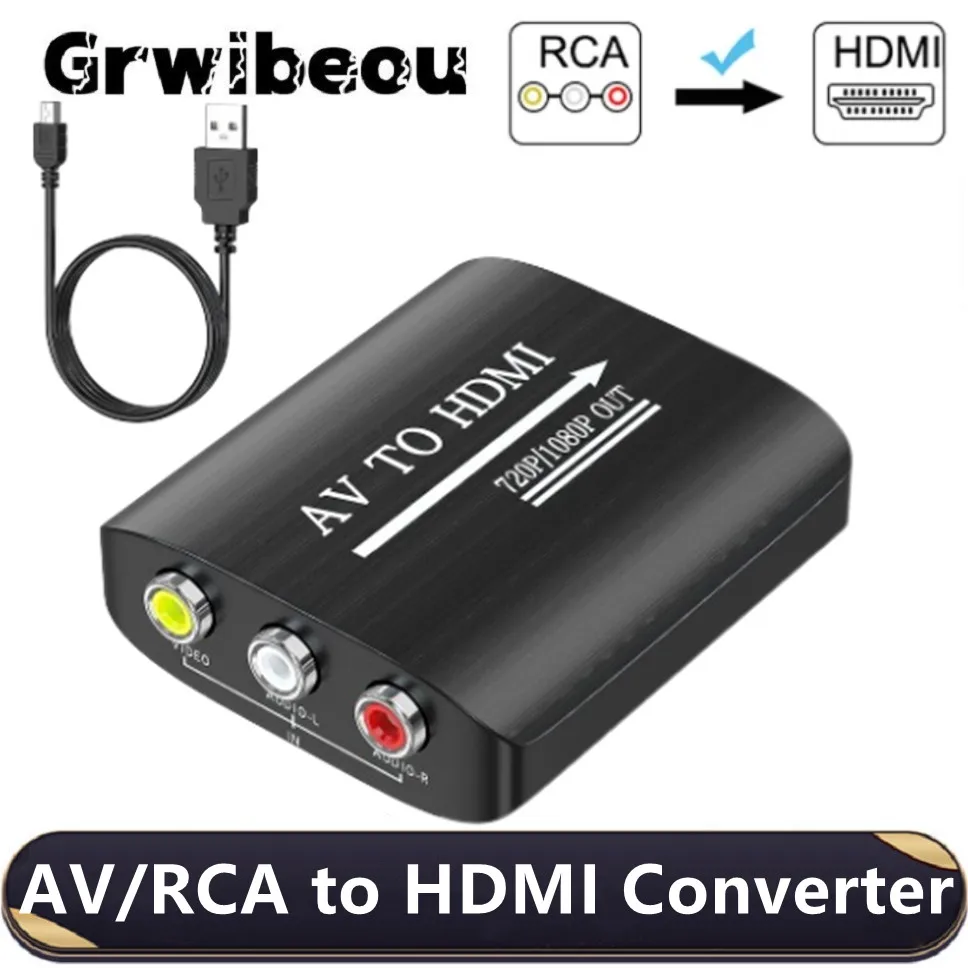
This converter features standard RCA composite video (yellow) and stereo audio (red/white) inputs. These are the ubiquitous connectors found on a vast array of older consumer electronics, from the Nintendo 64 to classic VCRs.
Its primary function is to take these separate analog signals and combine them into a single, digital HDMI stream. This active conversion process is crucial, as a simple passive cable cannot perform the necessary signal processing to translate analog waveforms into digital packets. The device effectively extends the lifespan of beloved retro hardware, preventing the need to discard functional, albeit older, equipment.
Unlike direct cable adapters that merely change the physical connector type, this unit actively processes the signal. Many older devices output signals that modern displays simply cannot interpret without dedicated circuitry. This converter provides that essential circuitry, ensuring compatibility and a viewable image.
The input side clearly displays the three color-coded RCA jacks: yellow for composite video, and red and white for left and right stereo audio. This standardized layout ensures intuitive connection for anyone familiar with analog AV equipment. Connecting is simple.
On the output side, a single HDMI port is present, ready to transmit the converted digital signal to a display. HDMI (High-Definition Multimedia Interface) is the current standard for transmitting high-definition video and audio over a single cable, simplifying home theater setups considerably. This single cable solution reduces clutter.
This design contrasts sharply with the multi-cable spaghetti often associated with older analog setups. The consolidation into a single HDMI cable streamlines connectivity and reduces potential points of failure, a significant advantage for any repair technician troubleshooting a home entertainment system.
An important feature of this converter is its ability to output at either 720P or 1080P resolution. A small switch on the unit allows the user to select the desired output resolution. This provides flexibility.
This upscaling capability means that while the original analog source material remains standard definition, the converter formats it to a resolution more palatable for high-definition displays. It doesn't magically enhance the source quality, but it ensures the image fills the screen without excessive pixelation or stretching artifacts that often plague direct connections of low-resolution sources to high-resolution panels. The image is clearer.
Compared to simply stretching a 480i signal across a 1080p screen, which often results in a blurry and distorted image, the active upscaling performed by this converter provides a more visually acceptable presentation. It's a practical compromise between preserving original content and adapting to modern display technology.
Upscaling involves interpolating pixels to fill the higher resolution grid of the HDMI output. While this process cannot add detail that was not present in the original analog signal, it can smooth jagged edges and provide a more coherent image. This is particularly beneficial for older video games, where blocky graphics can become even more pronounced on large HD screens. The visual experience improves.
Understanding that this is an upscaler, not a quality enhancer, is crucial for managing expectations. The device performs its function by making the old signal compatible and presentable, not by magically transforming it into true high-definition content. It's about compatibility first.
For technicians, this means setting realistic expectations for clients. The converter solves a connectivity problem, but it cannot compensate for the inherent limitations of standard definition source material. It's a bridge, not a magic wand.
The Grwibeou converter requires external power, supplied via a USB 5V 1A input. A USB power cable is included, which can be connected to a standard USB wall adapter (not included) or a USB port on a television or console. Power is essential.
This active power supply is a critical distinction from passive adapters. Active conversion circuitry, necessary for the analog-to-digital transformation and upscaling, demands a stable power source. This ensures consistent performance and signal stability, preventing flickering or signal dropouts that can occur with underpowered or passive solutions. Stable power means stable video.
Many simpler, cheaper adapters attempt to draw power directly from the HDMI source, often leading to unreliable operation or compatibility issues. The dedicated 5V 1A USB power input mitigates these risks, providing the necessary juice for the internal processing chips to function optimally. This design choice prioritizes reliability.
The use of a standard USB power input offers significant flexibility. Most households have numerous USB chargers available, or modern TVs often include USB service ports that can power such a device. This reduces the need for a dedicated power brick, simplifying setup. It's very convenient.
From a repair standpoint, the standard USB power input is a benefit. If the device experiences power-related issues, troubleshooting can begin with simply swapping out the USB cable or power adapter, which are readily available and inexpensive components. This simplifies diagnostics.
Ensuring a stable 5V 1A power supply is paramount for the converter's longevity and performance. Using an underpowered source could lead to intermittent operation or premature failure of internal components. Always use a proper power source.
Setting up the Grwibeou converter is remarkably straightforward. The clearly labeled RCA inputs and HDMI output, combined with the single 720P/1080P switch, make operation intuitive. No complex software or driver installations are required. It's plug-and-play.
The visual diagrams provided with the product clearly illustrate the connection flow: analog source to converter, converter to HDMI display. This visual guidance minimizes potential user error during installation. Setup is easy.
Unlike more complex video processing units that might require extensive calibration or menu navigation, this converter offers a minimalist approach. Its simplicity is a key advantage for users who simply want to connect their old devices without a steep learning curve. It just works.
The compact form factor of the converter also contributes to its ease of use. It can be tucked away behind a television or console without adding significant bulk to an entertainment setup. Its small size is a plus.
For a repair technician, the simplicity of installation means fewer support calls related to setup issues. The clear labeling and minimal controls reduce ambiguity, allowing users to quickly get their legacy systems up and running. This saves time.
However, it is important to note the explicit warning: this is a one-way conversion (AV to HDMI only). Attempting to use it in reverse (HDMI to AV) will not work and could potentially damage the unit or connected devices. Directionality is critical.
The converter is housed in a compact, matte black plastic casing. While not designed for rugged industrial use, the enclosure appears sufficiently robust for typical home entertainment environments. The plastic protects internal components.
The RCA and HDMI ports feature standard metal connectors. These are generally durable for repeated insertions and removals, provided reasonable care is taken. The USB power port is also a common, robust design. Connectors are standard.
For its price point, the visible material quality is adequate. The device is intended to be a stationary component in an entertainment system, not a portable item subjected to constant travel and potential impacts. It's built for purpose.
The sealed nature of the casing suggests that the internal circuitry is protected from dust and minor spills, which is beneficial for longevity in a home environment. While internal solder quality cannot be visually assessed, the widespread availability of such devices indicates a manufacturing process that, while cost-effective, generally meets basic functional requirements. Protection is good.
As a repair technician, the sealed unit means that internal repairs are generally not feasible or cost-effective. The device is designed to be a replacement unit rather than a repairable one, which is typical for electronics in this price bracket. Replacement is the norm.
Proper cable management and avoiding undue strain on the connectors will significantly extend the operational life of the unit. Yanking cables or placing the converter in a precarious position can lead to premature failure of the ports. Handle with care.
From a repair technician's standpoint, the Grwibeou AV to HDMI converter is a valuable tool for solving compatibility issues. Its adherence to standardized connector types (RCA, HDMI, USB) is a significant advantage. This ensures broad compatibility with existing cabling infrastructure, reducing the need for specialized or hard-to-find proprietary cables. Standard connectors simplify things.
The explicit one-way conversion (AV to HDMI) is a critical piece of information for troubleshooting. Many users mistakenly assume bidirectional functionality, leading to frustration. Clear communication about this limitation prevents unnecessary service calls. Direction matters.
Compared to attempting to source older televisions or complex multi-input receivers, this converter offers a simple, cost-effective solution for integrating legacy devices. It's a practical fix. The device's straightforward design minimizes potential points of failure, making it a reliable component in a retro setup. Fewer parts, fewer problems.
When troubleshooting a system incorporating this converter, a technician would first verify power supply, then check all cable connections for proper seating and integrity. The 720P/1080P switch is another point of potential user error to check. Simple checks resolve most issues.
Pinout accuracy is implicitly handled by the device's design for standard AV composite and stereo audio. If the source device is outputting a standard signal, the converter should process it correctly. Any signal issues would then point to the source device, the cables, or the display itself, rather than the converter's fundamental signal interpretation. It's a reliable link.
This converter effectively removes one layer of complexity from troubleshooting older systems connected to modern displays. Its predictable behavior allows technicians to isolate problems more efficiently, focusing on other components of the signal chain. It simplifies diagnostics.
The Grwibeou AV to HDMI Converter stands as an essential accessory for anyone looking to bridge the gap between classic analog entertainment systems and contemporary digital displays. Its straightforward operation, active signal conversion, and resolution upscaling capabilities make it a practical and cost-effective solution. Imagine effortlessly connecting your cherished Nintendo 64 or your vintage VCR to your crisp 4K television, reliving nostalgic moments with minimal fuss and maximum compatibility. This device ensures that your favorite retro games and classic movies are not relegated to dusty storage, but remain a vibrant part of your modern entertainment setup, ready to be enjoyed at a moment's notice. It's time to bring those memories back to life, displayed beautifully on your current screen, without the headache of incompatible ports or blurry images. Embrace the past, seamlessly integrated with the present.
Bridging the Analog-Digital Divide
This converter features standard RCA composite video (yellow) and stereo audio (red/white) inputs. These are the ubiquitous connectors found on a vast array of older consumer electronics, from the Nintendo 64 to classic VCRs.
Its primary function is to take these separate analog signals and combine them into a single, digital HDMI stream. This active conversion process is crucial, as a simple passive cable cannot perform the necessary signal processing to translate analog waveforms into digital packets. The device effectively extends the lifespan of beloved retro hardware, preventing the need to discard functional, albeit older, equipment.
Unlike direct cable adapters that merely change the physical connector type, this unit actively processes the signal. Many older devices output signals that modern displays simply cannot interpret without dedicated circuitry. This converter provides that essential circuitry, ensuring compatibility and a viewable image.
Input and Output Architecture
The input side clearly displays the three color-coded RCA jacks: yellow for composite video, and red and white for left and right stereo audio. This standardized layout ensures intuitive connection for anyone familiar with analog AV equipment. Connecting is simple.
On the output side, a single HDMI port is present, ready to transmit the converted digital signal to a display. HDMI (High-Definition Multimedia Interface) is the current standard for transmitting high-definition video and audio over a single cable, simplifying home theater setups considerably. This single cable solution reduces clutter.
This design contrasts sharply with the multi-cable spaghetti often associated with older analog setups. The consolidation into a single HDMI cable streamlines connectivity and reduces potential points of failure, a significant advantage for any repair technician troubleshooting a home entertainment system.
Signal Integrity and Resolution Handling
An important feature of this converter is its ability to output at either 720P or 1080P resolution. A small switch on the unit allows the user to select the desired output resolution. This provides flexibility.
This upscaling capability means that while the original analog source material remains standard definition, the converter formats it to a resolution more palatable for high-definition displays. It doesn't magically enhance the source quality, but it ensures the image fills the screen without excessive pixelation or stretching artifacts that often plague direct connections of low-resolution sources to high-resolution panels. The image is clearer.
Compared to simply stretching a 480i signal across a 1080p screen, which often results in a blurry and distorted image, the active upscaling performed by this converter provides a more visually acceptable presentation. It's a practical compromise between preserving original content and adapting to modern display technology.
The Upscaling Process
Upscaling involves interpolating pixels to fill the higher resolution grid of the HDMI output. While this process cannot add detail that was not present in the original analog signal, it can smooth jagged edges and provide a more coherent image. This is particularly beneficial for older video games, where blocky graphics can become even more pronounced on large HD screens. The visual experience improves.
Understanding that this is an upscaler, not a quality enhancer, is crucial for managing expectations. The device performs its function by making the old signal compatible and presentable, not by magically transforming it into true high-definition content. It's about compatibility first.
For technicians, this means setting realistic expectations for clients. The converter solves a connectivity problem, but it cannot compensate for the inherent limitations of standard definition source material. It's a bridge, not a magic wand.
Powering the Conversion
The Grwibeou converter requires external power, supplied via a USB 5V 1A input. A USB power cable is included, which can be connected to a standard USB wall adapter (not included) or a USB port on a television or console. Power is essential.
This active power supply is a critical distinction from passive adapters. Active conversion circuitry, necessary for the analog-to-digital transformation and upscaling, demands a stable power source. This ensures consistent performance and signal stability, preventing flickering or signal dropouts that can occur with underpowered or passive solutions. Stable power means stable video.
Many simpler, cheaper adapters attempt to draw power directly from the HDMI source, often leading to unreliable operation or compatibility issues. The dedicated 5V 1A USB power input mitigates these risks, providing the necessary juice for the internal processing chips to function optimally. This design choice prioritizes reliability.
Power Source Flexibility
The use of a standard USB power input offers significant flexibility. Most households have numerous USB chargers available, or modern TVs often include USB service ports that can power such a device. This reduces the need for a dedicated power brick, simplifying setup. It's very convenient.
From a repair standpoint, the standard USB power input is a benefit. If the device experiences power-related issues, troubleshooting can begin with simply swapping out the USB cable or power adapter, which are readily available and inexpensive components. This simplifies diagnostics.
Ensuring a stable 5V 1A power supply is paramount for the converter's longevity and performance. Using an underpowered source could lead to intermittent operation or premature failure of internal components. Always use a proper power source.
Installation and Operational Simplicity
Setting up the Grwibeou converter is remarkably straightforward. The clearly labeled RCA inputs and HDMI output, combined with the single 720P/1080P switch, make operation intuitive. No complex software or driver installations are required. It's plug-and-play.
The visual diagrams provided with the product clearly illustrate the connection flow: analog source to converter, converter to HDMI display. This visual guidance minimizes potential user error during installation. Setup is easy.
Unlike more complex video processing units that might require extensive calibration or menu navigation, this converter offers a minimalist approach. Its simplicity is a key advantage for users who simply want to connect their old devices without a steep learning curve. It just works.
User-Friendly Design
The compact form factor of the converter also contributes to its ease of use. It can be tucked away behind a television or console without adding significant bulk to an entertainment setup. Its small size is a plus.
For a repair technician, the simplicity of installation means fewer support calls related to setup issues. The clear labeling and minimal controls reduce ambiguity, allowing users to quickly get their legacy systems up and running. This saves time.
However, it is important to note the explicit warning: this is a one-way conversion (AV to HDMI only). Attempting to use it in reverse (HDMI to AV) will not work and could potentially damage the unit or connected devices. Directionality is critical.
Material Durability and Connector Longevity
The converter is housed in a compact, matte black plastic casing. While not designed for rugged industrial use, the enclosure appears sufficiently robust for typical home entertainment environments. The plastic protects internal components.
The RCA and HDMI ports feature standard metal connectors. These are generally durable for repeated insertions and removals, provided reasonable care is taken. The USB power port is also a common, robust design. Connectors are standard.
For its price point, the visible material quality is adequate. The device is intended to be a stationary component in an entertainment system, not a portable item subjected to constant travel and potential impacts. It's built for purpose.
Internal Component Protection
The sealed nature of the casing suggests that the internal circuitry is protected from dust and minor spills, which is beneficial for longevity in a home environment. While internal solder quality cannot be visually assessed, the widespread availability of such devices indicates a manufacturing process that, while cost-effective, generally meets basic functional requirements. Protection is good.
As a repair technician, the sealed unit means that internal repairs are generally not feasible or cost-effective. The device is designed to be a replacement unit rather than a repairable one, which is typical for electronics in this price bracket. Replacement is the norm.
Proper cable management and avoiding undue strain on the connectors will significantly extend the operational life of the unit. Yanking cables or placing the converter in a precarious position can lead to premature failure of the ports. Handle with care.
The Repair Technician's Perspective
From a repair technician's standpoint, the Grwibeou AV to HDMI converter is a valuable tool for solving compatibility issues. Its adherence to standardized connector types (RCA, HDMI, USB) is a significant advantage. This ensures broad compatibility with existing cabling infrastructure, reducing the need for specialized or hard-to-find proprietary cables. Standard connectors simplify things.
The explicit one-way conversion (AV to HDMI) is a critical piece of information for troubleshooting. Many users mistakenly assume bidirectional functionality, leading to frustration. Clear communication about this limitation prevents unnecessary service calls. Direction matters.
Compared to attempting to source older televisions or complex multi-input receivers, this converter offers a simple, cost-effective solution for integrating legacy devices. It's a practical fix. The device's straightforward design minimizes potential points of failure, making it a reliable component in a retro setup. Fewer parts, fewer problems.
Diagnosing Connectivity Issues
When troubleshooting a system incorporating this converter, a technician would first verify power supply, then check all cable connections for proper seating and integrity. The 720P/1080P switch is another point of potential user error to check. Simple checks resolve most issues.
Pinout accuracy is implicitly handled by the device's design for standard AV composite and stereo audio. If the source device is outputting a standard signal, the converter should process it correctly. Any signal issues would then point to the source device, the cables, or the display itself, rather than the converter's fundamental signal interpretation. It's a reliable link.
This converter effectively removes one layer of complexity from troubleshooting older systems connected to modern displays. Its predictable behavior allows technicians to isolate problems more efficiently, focusing on other components of the signal chain. It simplifies diagnostics.
Conclusion: Reconnecting with the Past
The Grwibeou AV to HDMI Converter stands as an essential accessory for anyone looking to bridge the gap between classic analog entertainment systems and contemporary digital displays. Its straightforward operation, active signal conversion, and resolution upscaling capabilities make it a practical and cost-effective solution. Imagine effortlessly connecting your cherished Nintendo 64 or your vintage VCR to your crisp 4K television, reliving nostalgic moments with minimal fuss and maximum compatibility. This device ensures that your favorite retro games and classic movies are not relegated to dusty storage, but remain a vibrant part of your modern entertainment setup, ready to be enjoyed at a moment's notice. It's time to bring those memories back to life, displayed beautifully on your current screen, without the headache of incompatible ports or blurry images. Embrace the past, seamlessly integrated with the present.