DC 12V 433MHz Wireless RF Remote Control Relay Switch
Official Store Deal
Expert Analysis Overview
Precision Control: A Repair Technician's Perspective on the 433MHz Wireless Relay Switch
The DC 12V 433MHz Wireless RF Remote Control Relay Switch is a compact, single-channel (1CH) receiver paired with a two-channel (2CH) transmitter, engineered for low-voltage switching applications. This system is primarily aimed at technicians and DIY enthusiasts seeking to integrate remote control functionality into existing DC 12V circuits, particularly for door electromagnetic locks, lighting systems, or small motor control. Its design emphasizes straightforward integration and reliable operation, making it a practical solution for common automation challenges.
Receiver Module Analysis
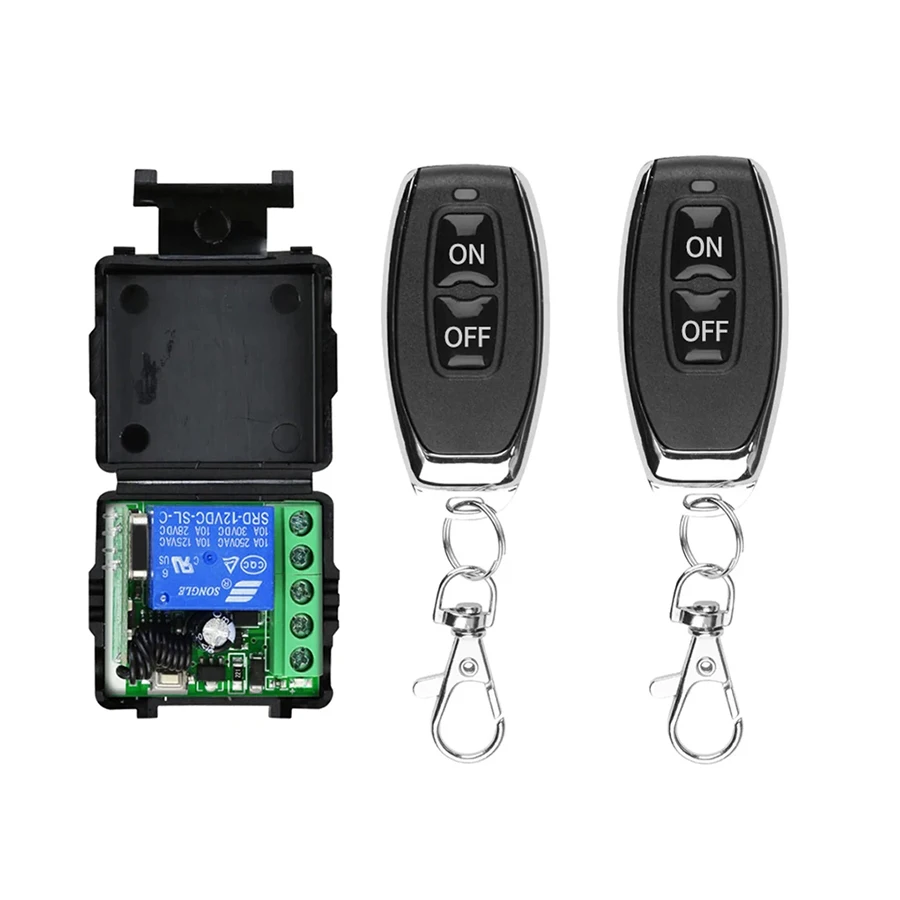
The receiver module, housed within a robust plastic enclosure, clearly displays its internal components. Visible are the main PCB, a blue SRD-12VDC-SL-C relay, and screw terminals for power input and load connection. The PCB layout appears clean, with clearly marked solder points and component placements. This modularity is a significant advantage for repair technicians. Unlike integrated systems that require complete unit replacement, individual components on this board, such as the relay or input capacitors, could potentially be desoldered and replaced if a fault occurs. This extends the operational life of the unit and reduces long-term maintenance costs.
The 10A relay rating is a critical specification. This capacity allows the module to handle a substantial range of DC 12V loads, from simple LED strips to more demanding electromagnetic door locks or small DC motors. The screw terminals provide a secure and reliable connection point for wiring, which is essential for preventing intermittent faults or power loss in critical applications. Proper wire gauge selection is paramount for sustained 10A operation. Technicians often encounter systems with undersized wiring, leading to voltage drop and overheating. This module's terminals are adequately sized for the rated current, promoting safe installation practices.
Compared to generic, unrated relay modules, this unit's explicit 10A rating provides a clear operational envelope. Many off-the-shelf modules offer ambiguous current ratings or use lower-quality relays that quickly degrade under load. The visible SRD-12VDC-SL-C relay is a common, well-documented component, which simplifies troubleshooting and replacement if necessary. This transparency in component choice instills confidence in its stated capabilities, a factor often overlooked in budget-friendly electronics.
Transmitter Ergonomics and Functionality
The two included transmitters are designed as compact key fobs, featuring distinct 'ON' and 'OFF' buttons. Their small form factor makes them convenient for everyday carry, similar to a car remote. The tactile feedback from the buttons appears positive, suggesting a clear actuation point. This prevents accidental presses and ensures reliable command transmission. The inclusion of two transmitters offers redundancy or allows for control from multiple locations, a practical consideration for many installations.
Operating at 433MHz, the RF signal provides a reasonable range for most residential or small commercial applications. This frequency is less susceptible to interference from Wi-Fi or Bluetooth devices, which typically operate at 2.4GHz. The signal penetration through walls and obstacles is generally better at lower frequencies, enhancing its utility in diverse environments. A clear line of sight is not always required for effective operation. This is a significant benefit over infrared (IR) remote controls, which demand direct visual alignment.
Standard remote control systems often suffer from limited range or susceptibility to common household interference. This 433MHz system, while not offering the encrypted security of more advanced protocols, provides a robust and widely adopted solution for basic remote switching. The simplicity of its two-button interface means minimal learning curve for end-users. It is a straightforward 'point and click' operation. This contrasts with multi-function remotes that can be overly complex for simple on/off tasks.
Installation Considerations
The receiver's enclosure is designed for easy mounting, likely with screw tabs or a simple clip mechanism. This facilitates secure placement within an electrical box or near the controlled device. Proper installation is crucial for both functionality and safety. The DC 12V input voltage is standard for many low-voltage systems, simplifying power sourcing. A stable 12V DC supply is essential for optimal relay operation and to prevent premature component failure.
Wiring the unit involves connecting the 12V DC power supply to the input terminals and the load to the relay's output terminals. The relay typically offers normally open (NO) and common (COM) contacts, allowing for flexible integration into various circuits. Understanding basic relay logic is necessary for correct wiring. Incorrect polarity or overloading the relay can lead to immediate failure. Always verify wiring diagrams before applying power. This prevents costly damage.
Compared to hardwired switches, this wireless solution eliminates the need for running extensive control wiring, significantly reducing installation time and material costs. This is particularly beneficial in retrofit scenarios or when physical wiring is impractical. The ability to add remote control without tearing into walls or ceilings offers substantial value. It simplifies complex installations. This makes it an attractive option for both professional installers and DIYers.
Application Versatility and Durability
The versatility of this wireless switch extends beyond door locks. It can control various 12V DC devices, including garage door openers, car alarms, lighting systems, irrigation pumps, and even custom automation projects. Its broad applicability makes it a valuable component in a technician's toolkit. The robust plastic casing provides adequate protection for the internal electronics against dust and minor impacts. While not explicitly rated for outdoor use, its enclosure offers a degree of environmental resistance for indoor or sheltered outdoor installations.
The operational lifespan of the relay is a key durability factor. Electromechanical relays have a finite number of switching cycles. For applications requiring frequent switching, this should be considered. However, for typical intermittent use, the relay should provide years of reliable service. Regular inspection of the terminals for corrosion or loose connections can further extend its operational life. Preventative maintenance is always recommended. This ensures long-term reliability.
Many generic wireless switches on the market often compromise on build quality, using flimsy plastics or unsealed enclosures. This unit's visible construction suggests a more considered approach to durability, especially for its price point. The screw terminals, rather than soldered wires, enhance its serviceability and robustness against vibration. This design choice is indicative of a product intended for practical, long-term use. It is a solid choice for demanding applications.
Longevity and Repairability
From a repair technician's standpoint, the openable enclosure and visible PCB are significant advantages. Should a component fail, diagnosis and replacement are feasible, unlike many sealed, disposable electronic modules. The use of standard components like the SRD-12VDC-SL-C relay means replacements are readily available. This reduces downtime and the cost of ownership. The ability to repair rather than replace entire units is a sustainable and cost-effective approach.
The simplicity of the circuit design also aids in troubleshooting. With basic multimeter skills, a technician can quickly identify power issues, relay faults, or signal reception problems. The absence of complex microcontrollers or proprietary components simplifies the repair process. This makes it accessible even to hobbyists. It is a straightforward design. This promotes user-level maintenance.
Compared to highly integrated, surface-mount technology (SMT) heavy designs, this module's through-hole components are much easier to work with for soldering and desoldering operations. This makes it an ideal candidate for educational projects or for technicians who prefer traditional repair methods. The design prioritizes functionality and serviceability. This is a refreshing change from disposable electronics. It offers a practical solution for many users.
Imagine the convenience of remotely activating your garage door from your car, or switching on outdoor lighting from inside your home, all with a simple, reliable click. This wireless switch system provides that capability, offering a practical and cost-effective solution for automating everyday tasks. Its robust design and straightforward operation ensure consistent performance, simplifying your daily routines and enhancing control over your environment. This system delivers dependable remote functionality.